TRON ARES
I got called up by the legendary GMUNK and Mr. Jayse Hansen to come in and be the MOTION DIRECTOR for the UI in Tron Ares. I’m talking HUDs, Holograms,
AND CRAZY SCREENS AND STUFF.
———————————————————————————————————————————————————————————————————————————————————————————————————
THE MOTION OF ARES HUD
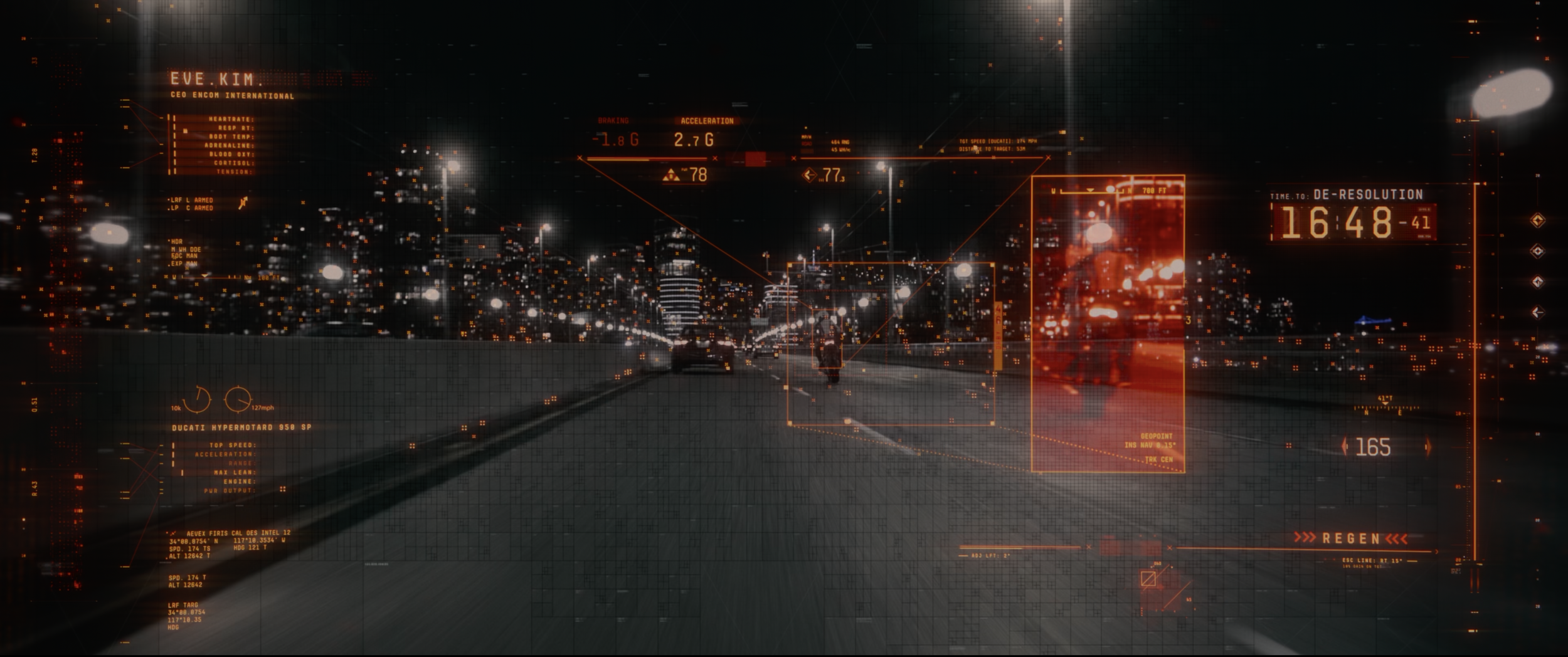
When I came on to the film (Sept 2024), Jayse had already been deep in dev land as design director trying to figure out how to make some brutalist AI HEAT for Ares HUD shots. This HUD was very unique in the structure of the shots. Not only were we designing graphics, we also had a squarepacking element we were doing to the plate (handled by the very talented Ryan Cashman). Because of this we ended up getting stretched in to new territory for HUDs in film. Instead of the UI graphics highlighting the plate, we had to figure out how to have the graphics play nice with the wild cube vision. Munk also wanted the HUD crisp and sharp. No comping to hide behind…
My task was the come up with how the HUD UI Graphics moved and worked. There was no animation happening when I joined, and I was the first one to lay down some keyframes and figure out how this thing could breathe. I also took the cube vision passes and played with scans, wipes, flashes, etc that could help everything stay alive and AI - y.
Once I did that, GMUNK was counting on me to lead the team as the MOTION DIRECTOR for the film. No pressure!
Part of the internal conversations early on included talk of neurons, fleeting thoughts, hyper active, AI of course, constant moving, once they are there - they are already gone. These ideas were the building blocks for how I approached the motion of Ares. He’s an AI trying to make sense of the world. He has all the information he could ever want, and he’s thinking with that in mind, but he only really needs something specific per shot. We wanted to communicate the vastness of what he has available to him as an AI, but also make it digestible to the audience.
GMUNK was key here, and really really pushed me early on to keep getting faster and faster. Eventually I was animating on literal 1f beats, with lots of things popping on. I had to let the side of me that wanted a pretty cascade take a back seat, and step into a mindset that was focused on making the UI graphics feel directive based, logical, intentional, no need for anything cute or fluffy to happen. Ares is a killer and has one mission, no need for it to feel like a piece of Stark tech.
As you can imagine we went through many different versions of look dev on this HUD. From graphics, to movement, treatment, the square packing, it was all a process creatively. Every aspect influence the other, and to find the right balance we needed the right captain at the helm (GMUNK).
I remember the shot we were dev’ing that made everything click. In the film there’s a sequence towards the beginning called DBP. Dillinger is presenting Ares to the board of directors to try and sway their investments, and the future of Dillinger systems. The specific shot in the sequence was DBP2030, one of the first shots we touched when pitching the HUD. Though we were touching other shots at the time, it took about 2-3 months on 2030 to really figure out how we wanted this HUD to really look.
With DBP2030, about 3 months in to the process, we hit a rhythm that we rippled out to the rest of the shots. One of the issues we were having was the sense of movement. We had tons of data, and a new way to create tracking markers that felt alive, but we didn’t have something that felt…. like it was processing. Something to draw the eye of the viewer that wasn’t just another selector like all HUDs had. I remember I was listening to rumble by Skrillex around this time, and there was a pulsing sound that reminded me of the missing feeling in the HUD. Once I made a UI widget that felt in the world with that sound, everything in the HUD clicked, and the rhythm became apparent for all other UI graphic elements in the HUD.
It’s funny how something as small as a selection box made everything else start to have a sense of weight. It’s a great example of letting yourself not adhere to any rules creatively, and letting the shot tell you what it needs.
———————————————————————————————————————————————————————————————————————————————————————————————————
THE MOTION OF THE GRID
With Ares HUD well underway, and a formula ready for me to pass to the new comers on the team, my attention started to move to the ASE sequence. After hacking Encom, Ares has a collection of files that he retrieved. Loading them up in the Grid, Ares is able to sort through all the information volumetrically.
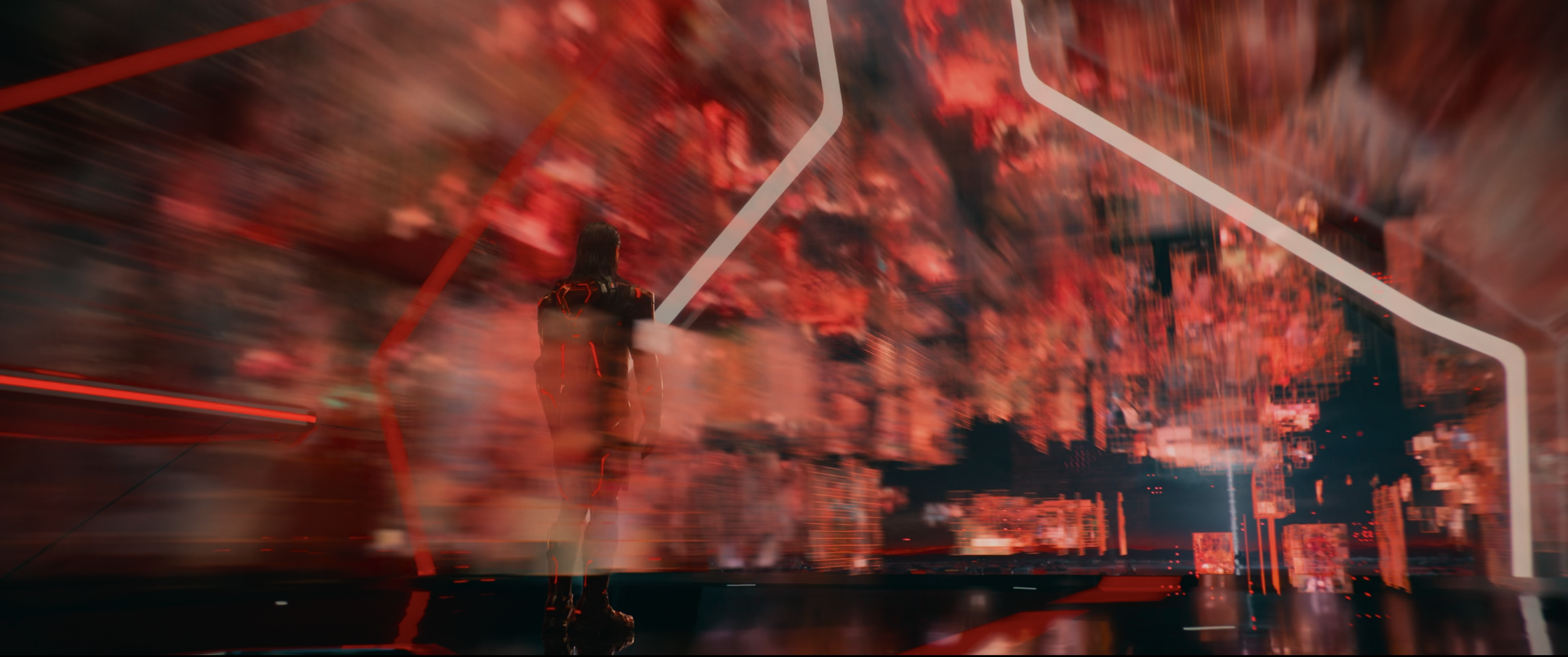
The floating panes of information that storm past Ares were handled by our super talented Houdini team. Adam Swaab, Serjan Burlak, and Daniela Levy. The UII however, were again tagged teamed between me and Jayse. Like the HUDs I got to throw in some designs here and there, but Mr. Hansen set us up for success with his awesome design language.
My main objective was trying to figure out how this character of the grid would work. Unlike the HUD, which is an extension of Ares, this holographic moment represents how the grid interacts with programs. Think of it how Jarvis would interact with Tony in his workshop. Yes there’s an obvious approach because it’s supposed to be tech, but there’s also a special way we need to lay it out so it has its own language. It needed to feel similar in world to the HUD, but also needed to be entirely different.
The UI graphics are more light based and less crisp LCD. With motion blur (of course), sweeps, shuffling to organize volumetrically, these UI graphics utilized 3D space and felt alive. Working closely with ILM, we could receive shot cameras that were dev’d with the director Joachim Rønning. I would take where they got, and work out how the story beats could be best represented with their movements. Sometimes it was just a stationary shot with a little wobble, and other times the camera would sweep with a big move. The variety kept the sequence interesting and provided a lot of fun moments to creatively solve.
With each new addition of information, the grid would respond and maintain order by placing things in their perfect positional hierarchy. Things had a more cause and effect than the HUD. You’ll see something pop that would affect the rest of the UI. I didn’t want anything to act stationary in space, but to move as if it was alive and organic. Here are three great examples to show you what I’m talking about.
———————————————————————————————————————————————————————————————————————————————————————————————————
Tron Ares is one of those jobs that only come a few times in your career. We were given the opportunity to contribute to an IP that is synonymous with the best visual talent in the world. Getting to run wild and push boundaries graphically (with one of the most fun and energetic teams) was really an honor. Tron Legacy came out when I was 12 years old, and its design and language shaped my interest in movies and art - a huge reason I am where I am as an artist. To get to contribute back to the franchise that helped shaped young me as an artist an filmmaker, was a unique opportunity I do not take for granted.
Production: Walt_Disney_Pictures
Director: Joachim_Rønning
VFX Supervisor ILM: David_Seager
Production Designer: Darren_Gilford
Designed for: Gmunk_Studios,_INC
VFX Design Supervisor: Bradley_G._Munkowitz
GFX Design Lead: Jayse_Hansen
GFX Motion Director: Darby_Faccinto
VFX Executive Producer: Simona_Bunardzhieva
VFX Executive Staff: Asher_Edwards
VFX Producer: Matteo_J.D._Veglia
VFX Coordinator: Christian_Trineer
JAMM VFX Supervisor: Troy_Moore
JAMM VFX Producer: Justine_Pregler
JAMM CG Supervisor: Zak_Dimaria
Lead GFX Artists: Toros_Köse, Justin_Hemsley, Daniel_Lazo, Christian_Haberkern
Lead VFX Artists: Adam_Swaab, Ryan_Cashman, Serjan_Burlak, Fred_Hopp
GFX Artists: Cisco_Torres, Pedro _Flemming, Seth_Molson, Angie_Feret, Ryan_Close, Kasey_Amato, Peter_Clark, Robyn_Haddow,
VFX Artists: Stefano_Giorgetti, Kiersten_Yahn, Daniela_Levy, Ben_Martin, Caitlin_Roth